
The stubborn promise running my life
On inherited promises, organisational dissonance, and the practice that grew from trying not to look away.
My grandparents’ home was always full of life. Chaotic even. My uncle and his family lived upstairs. And at least one of the other six siblings would be in the kitchen or at the large dining table, coffee cup in hand. If bread, cheese, cold cuts, and butter weren’t on the table, it’d be cake. Until the day she died, my grandmother couldn’t understand how I could say no to butter. “Aber es ist doch die gute Butter, Kind.” But it’s the good butter, child.
Us kids, nine cousins at the time — that number has doubled since — owned the narrow street on the only hill in the region. We called it a mountain. Grandad would lose his mind whenever one of us would cut through the hedge to get to the neighbour’s. Two long driveways were just too much effort some days.
My aunts and uncles were always debating the finer points of something. Sometimes passion would take over, voices rise, and my 4’8” grandmother would be in between her children, telling them to calm down. My grandfather, not much taller than his wife, would be outside cussing at the weeds or talking to his neighbour across his precious boxwood hedge.
I remember sitting at that dining table and asking about the war. My grandmother had one sentence: "Das war eine schlimme Zeit, Kind." That was a terrible time, child. She said it the way you'd close a door — gently, but all the way. I asked more than once. I got the same answer more than once.
She and her sister had spent much of it hiding in an attic. I didn’t know this growing up. I knew my grandfather had gone to sea as a dental assistant, that his vessel had been scuttled, that he'd been reassigned to a minesweeper patrolling the Mediterranean. That ship too had been scuttled, and he'd ended the war a prisoner in France. His only comment on any of it, as far as I ever heard, was: "Zum Glück warens nicht die Russen." At least it wasn't the Russians.
As fate would have it, my grandad’s brother married my grandmother’s sister. They left their family in the Erzgebirge behind, not knowing they'd end up on opposite sides of borders that hadn't been drawn yet.
At school, we spent a lot of time with a single question: how did ordinary people let this happen? People who went to work, raised children, believed themselves reasonable. People who, if you pushed, would tell you it was a terrible time, child, and nothing more.
Where English classrooms had Lord of the Flies, German ones had Die Welle — same question, opposite diagnosis. Lord of the Flies asked what happened when civilisation fell away. Die Welle asked how quickly ordinary people could build something dangerous while still believing themselves reasonable.
We didn't just read it alone on the page; we discussed it out loud, argued it through together. A teacher, a classroom, an experiment in discipline and belonging that got away from everyone almost before anyone noticed.
That August, the television showed the asylum centre in Rostock-Lichtenhagen burning. Smoke filled the screen. People threw stones and petrol bombs while thousands stood outside and watched, some of them cheering. It went on for days. We’d already been taught exactly how this happens. Knowing wasn’t the same as having learned it.
Somewhere in the middle of understanding that it wasn’t one big thing but a lot of little things accumulating over time, I made myself a promise. Not the version I'd dress up in adult language now — closer to what a German tween actually thinks, half-formed and absolute: I will not be one of the ones who let it happen.
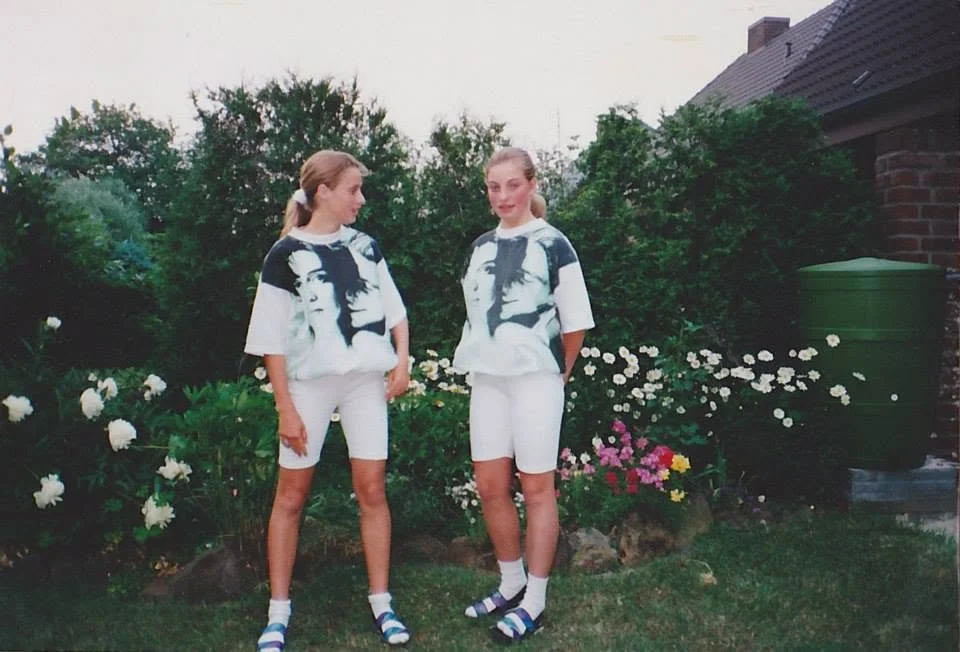
My bestie and me, identical t-shirts, and an unshakeable sense of how the world ought to be. Summer, early 1990s.
Decades later, that promise still runs my life. If I see harm and stay quiet when I could have been heard, I don't sleep. It isn't a value I hold and sometimes fail to live up to. It's closer to a floor that isn't there — the place where "staying silent" would sit, if it were still available to me as an option. It stopped being one the moment that tween made her promise.
This essay isn't about the war. It's about what that promise turned out to mean once I grew up and went looking for where else in life the same pattern lived: ordinary people, reasonable people, inside systems that proclaimed care and produced harm — not through malice, but through the simple mechanism of everyone believing they were only doing their job.
For a long time, I thought that promise was really about power — that I'd only be tested if I ever ended up in a position to prevent something. Wait for the moment, use it well. It took me longer than I'd like to notice the flaw in that. Prevention is conditional. It only asks something of you when you happen to have leverage.
What I actually meant — what the tween meant, before she had the words for it — was closer to a full rejection of complicity. Not looking away. Not making excuses. Not staying silent when there's a chance — even a small one — of being heard. I've never had much patience for ideological trench warfare — it’s never felt like energy well spent to me. But refusing to waste my energy on a lost cause is a different thing from staying quiet when there's somewhere for the words to land.
The promise carried something else with it, unexamined — not just about my family, not just about people who looked like me: everyone, everywhere has the right to live fully.
Plenty of people carry that same conviction and land somewhere else entirely — that a full life is something you build alone, and if you don't get there, that's a private failure rather than a shared one. I don't think I arrived where I did by being smarter or kinder than that view. I started somewhere plainer: we don't all start from the same place and we don't all have the same access. Once I let that in, individual responsibility stopped explaining much. Two people can try equally hard and land in entirely different lives, and the difference isn't effort.
But even that isn't quite it. It's not that individuals can't manage alone, as though the ideal were still to make it by yourself, and other people are just the backup plan. It's that none of us were ever doing it alone in the first place. We all inherited something. We all grew up inside norms and beliefs we didn't choose. We all live inside a context shaped by people and decisions long before us. We all carry hopes and dreams that were never going to survive in isolation. Becoming more of who we are has always been a relational act, not an individual one — not because we're too weak to do it alone, but because "alone" was never actually the way.
Cross-cultural psychology has a name for the kind of self I grew up assuming was the norm — the independent, self-authoring individual, optimising their own outcomes — and it's WEIRD: Western, Educated, Industrialised, Rich, Democratic. Not the standard. An anomaly. For decades, most of psychology's foundational research subjects came from that narrow slice of humanity, and the findings were nonetheless presented as truths about how minds work in general. Across most of human history, and much of the world today, selfhood has been understood as relational by default — defined through obligation, kinship, and interdependence, rather than personal achievement measured against everyone else.
The anthropologist Joseph Henrich traces much of the shift to the medieval Church's marriage rules, which spent centuries quietly dismantling the extended kin networks most societies had organised around — clearing the ground for the standalone individual to become thinkable in the first place. The self-made individual isn't ancient wisdom passed down from how humans have always lived. It's a recent, geographically narrow invention — a remarkably successful piece of marketing.
That’s where my work lives now: not in the belief itself, but in the gap between what systems claim and what they actually do. Not whether an organisation says it cares — most of them do — but what happens to the people inside it once that claim meets the day-to-day, and how the people it's meant to serve actually experience it. Whether the distance between the two closes over time or just looks like it has.
Before I get to systems, though, it’s worth going back even further than my grandparents’ dining room — to the stories that came before I had language for any of this, because it turns out they were carrying the same things all along, just at a smaller scale.
There was Ferdinand first — the bull who sits under his favourite cork tree smelling flowers while the other bulls charge each other for the honour of the bullring, and who, when they finally choose him for the fight, sits down in the middle of the ring and smells the flowers thrown into it. Everyone assumes he’s failed. Yet he’s simply refused to live someone else’s version of a full life, calmly, without needing anyone’s permission or apology.
There was Frederick, the field mouse who gathers no grain while his family stores up for winter, and who turns out, once the food runs low and the dark and cold set in, to have been gathering something else — sun, colour, words. He gives it back when the others need it most.
And there was Momo, and the fox from The Little Prince, teaching me the same thing from two directions at once. Momo’s gift was listening — sitting with people so completely that they found their own answers, without her ever offering one. The fox’s gift was the secret he traded the prince for being tamed: what is essential is invisible to the eye, and you only see it once you’ve taken the time to build a relationship. Neither of them fixed anyone. Neither of them diagnosed anyone. They paid attention, stayed in relationship, and let the other person’s existing strength surface on its own terms. You don’t install either one in a person. You create the conditions for them to notice what was already there.
Then there was the harder pair: Pippi Longstocking and Tistou of the Green Thumbs, who taught me the same lesson from the outside in rather than the inside out — because both of them spent their stories being informed, kindly, that the systems built to look after children knew better than they did.
Pippi has no school, no orphanage, no ordinary family, and every well-meaning adult around her treats those absences as a problem to correct, for her own good, of course. The authorities arrive to take her somewhere proper. The schoolteacher tries to fold her into a curriculum. Nobody in Pippi’s world is cruel exactly — they’re doing their jobs, following the procedure that exists to protect children like her. And yet what actually protects Pippi — her honesty, her strength, her refusal to be smaller than she is, her fierce loyalty to Tommy and Annika — has nothing to do with any of that and would arguably have been at risk if the procedure had worked.
Tistou is gentler about it, and somehow more damning. He’s expelled from ordinary school for asking too many questions — a system with a stated purpose punishing the exact trait that purpose is supposed to cultivate. Once he discovers he can make things grow, he doesn’t set out to dismantle anything. He just grows flowers — through the bars of a prison until the walls come down in blossom, through the barrels of guns until a weapons factory can’t make war anymore. The systems he changes were never evil by design. A prison and an army both come with a claim to purpose: justice, defence. Tistou doesn’t argue with the claim. He just makes it impossible to keep pretending the harm underneath it was necessary.
Both stories left me with the same seed, long before I had a name for it: that a system can be entirely sincere about the good it says it’s doing and still be the thing standing between a person and their own thriving. Ferdinand and Frederick and Momo and the fox had already told me people are trustworthy, resourceful, and worth relating to as equals. Pippi and Tistou told me the systems built around those people don’t always agree.
I grew up on flat, once-marshy land, with one hill in the whole region — we called it a mountain. In the city I now call home, the hills look like actual mountains, and people will raise an eyebrow if you call them anything but hills.
I was in my early twenties and had been in New Zealand for about three years when I took my first public-sector job. I didn’t take it because it was public sector; that part was incidental. But once I was in, I fell for its promise fast and started sensing the gap between that promise and its delivery almost as fast.
At New Zealand Customs, I worked as a uniformed officer at the public counter doing personal-effects clearances — working out whether what someone had shipped into the country was theirs to bring in free of duty, or whether it hid something that was subject to taxes, required a permit, or was simply prohibited.
One shipment was a classic car. A Porsche, if memory serves. The paperwork looked straightforward until it didn’t: the odometer readings on different documents didn’t match. When I raised it with the importer, he had a simple explanation. He’d replaced the old odometer while restoring the car and never wound the new one forward to match the distance it had actually travelled. No malice in it. Just an oversight.
It didn’t matter. An odometer that doesn’t reflect a vehicle’s true mileage makes the import prohibited, full stop. The rule existed for a reason: nobody wants to buy a car that’s travelled significantly further than its odometer promises. We seized the car.
At our end, it meant paperwork. At the importer’s end, it meant waiting for his car while the process took place. Neither cost was massive in the scheme of things. Once the formal process was complete, Customs had discretion over what happened to the car. We agreed on what seemed like the obvious fair path: return it to him, with the discrepancy noted on the car’s record, and without imposing any cost he wouldn’t have otherwise incurred.
The importer was fine with that. The public-protection purpose would be preserved, the car would come back to its owner, and the mistake would remain visible to anyone who needed to know about it later. It was, as far as I could tell, exactly how the system was supposed to work.
A couple of days later, my two-up — the manager of the operational area — took me aside and told me off. I should have come straight to him, he said. He would have just let the car go to the importer, discrepancy and all.
That was the part I couldn’t get past. A faster route to the same outcome wouldn’t have troubled me — I’d have taken it gladly. But “let it go” meant the mismatch would exist nowhere. Not on the car’s record, not anywhere.
The problem was never the shortcut. It was that the shortcut had nothing at the end of it.
All I could think was: you don’t have the authority to do that.
This is my first memory of organisational dissonance. Not that I had a name for it then — that came much later, after two decades of hitting what felt like the same wall over and over in different environments. Of watching capable people do the same. Of trying to get closer to the levers, only to find the same walls appearing again and again and again. The weirdest thing was that it was almost impossible to talk about any of it.
I think it was at Oranga Tamariki that I finally understood that passion and belief were not enough.
I joined in June 2019, just before a major legislative change came into effect. I was leading a new team whose job sat in the space between the change programmes and the frontline: advocacy, advice, communicating what was coming, and developing or improving the processes that needed national consistency.
The organisation was still separating from MSD. We were building the plane while we were flying it — a phrase spoken at least once an hour, sometimes as gallows humour, sometimes as an explanation, sometimes as a warning.
The work mattered. The people doing it cared. There was no shortage of passion or belief. But the more I watched, the clearer it became that caring about the purpose did not create the conditions needed to deliver it. The team could translate, advise, advocate, and improve processes. We could make the gap more visible. We could help people navigate what was coming. But we could not, by effort or conviction alone, make an unfinished system coherent.
That was a harder lesson than the one I had learned at Customs. At Customs, I had seen an individual attempt to bypass the record. At Oranga Tamariki, I began to see how a whole organisation could be full of people trying to do the right thing while the conditions around them made consistent, humane delivery extraordinarily difficult.
The problem was no longer simply whether someone had the authority to do something. Most people already knew what needed to happen. Sometimes even the how was clear. What wasn't there, often enough, was the connection between authority, information, responsibility, and reality that would have let anyone actually do it.
I was made redundant in August 2024. It took something from me, but it also gave me something I hadn’t been able to create from inside: distance, and the room to see the one wall as the many different patterns it had always been.
The stories came first — not stories about what was wrong, but about what might happen if different patterns were present in our organisations. It was only against that hope that the walls finally came into focus. One without the other was never going to be enough. Together, they became archetypes, creating a safer language for naming what is usually too risky or elusive to speak aloud. When they whispered: We can help others have those conversations that were impossible to have from inside, the tween answered: Then we must.
The wider practice grew around them: the conditions needed for people to see what they were carrying, name the constraints shaping their choices, and act while the work was still alive.
That is how the childhood promise has changed form. I can’t keep every system from producing harm. I can help people see what is happening sooner, share what they have been carrying alone, and protect the conditions in which a system might become answerable to the people it serves.
Cordula Plassmann is the founder of Cor Coaching, where she works with leaders and teams on organisational dissonance — the gap between what an organisation says it values and what it actually rewards. Her practice is built around the Nimacor™ methodology, which grew out of twenty years inside New Zealand's public sector, and includes 1:1 coaching, walk-and-talk sessions, and pattern-based work with teams. This piece is the thinking underneath that work.
